
About Foam Sclerotherapy
The circulatory system is made up of both veins and arteries. Arteries deliver fresh oxygen-rich blood from the heart to all tissues and veins then collect the oxygen-depleted blood again and transport it back to the heart.
The heart will pump blood through the arteries, but not all the way through the veins.
In the lower limbs, blood requires a different transport system to return it, against gravity, back to the heart. This transport system is made up of a pump again, the “calf pump” and one way valves within the veins.
It is for this reason that walking is a great way to keep your legs healthy, since the calf pump is activated all the time.
Broken one-way valves in the legs will cause blood to flow back through the vein and pool in the lower legs, this is known as venous reflux, and often presents as varicose veins. Varicose veins are large blue tortuous vessels that bulge from the surface of the skin.
Foam Sclerotherapy
What is ultrasound guided foam sclerotherapy?
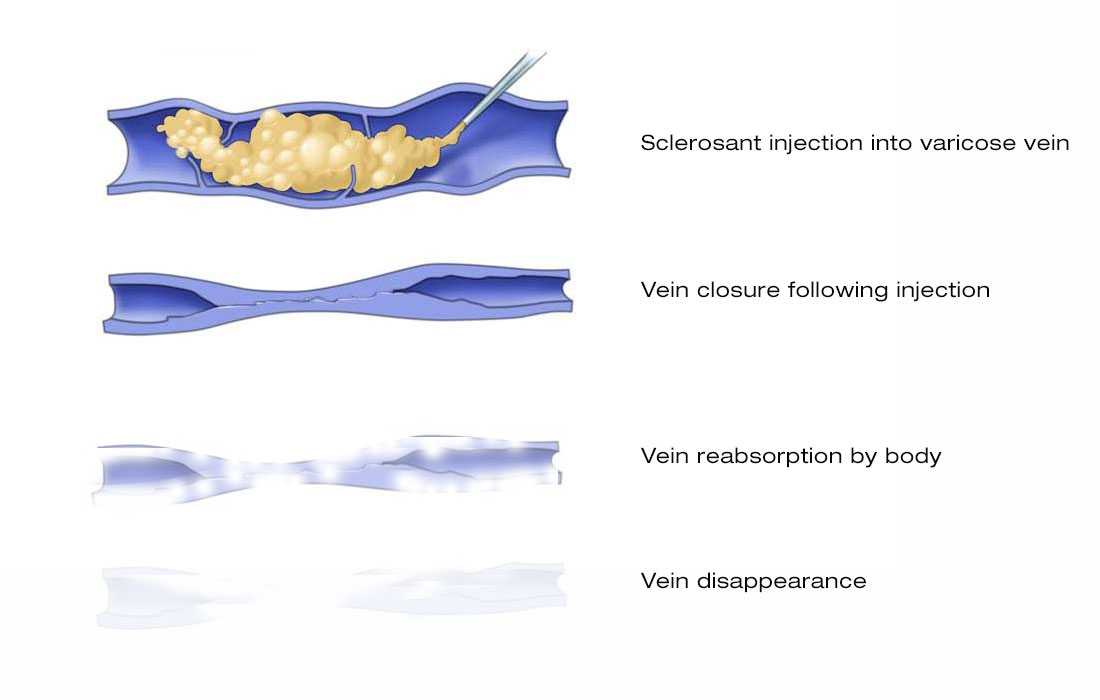
Sclerotherapy or injection of varicose veins is designed to improve the appearance of your varicose veins. The veins are injected with a solution called a sclerosant which damages the internal lining of the vein and causes blood to stop flowing through the vein. Over a period of time your own body will reabsorb the vein and it will disappear naturally. The chemical solution used is made specifically for the treatment of veins and is used in different concentrations. Foam sclerotherapy involves rapidly mixing volumes of the chemical solution with a small volume of air producing a white foam. Foam is able to fill even the most tortuous veins and it is for this reason that we use it, even large underlying abnormal veins can be treated. The procedure is performed under ultrasound guidance and control.
Your assessment is performed by Dr Johan Blignaut and includes duplex mapping before treatment is recommended. Treatment is selected according to your venous anatomy, not simply according to the veins visible on the skin.
How does it work?
Ultrasound guided foam sclerotherapy is performed in the office. It is particularly useful for veins that have returned after previous surgery, and for tortuous veins that are difficult to treat by other means. Dr Blignaut prefers to use radiofrequency ablation of the large veins and supplements this treatment with the use of foam sclerotherapy. The veins to be treated are identified using an ultrasound, they are sometimes marked on the skin. While lying on a treatment bed, a small needle is placed in the vein to be treated. The foam solution is mixed and injected into the vein. The injection itself is usually well tolerated, and most patients describe little discomfort. A compression bandage or stocking is immediately applied. This stocking or bandage is worn for several days following the injection.
Is foam sclerotherapy right for me?
Foam sclerotherapy is a suitable treatment for many patients with bulging varicose veins, and is often used in our clinics, usually alongside radiofrequency ablation of the underlying trunk rather than as a treatment on its own1. Outcomes depend on the size and distribution of the veins and on whether any underlying reflux has been treated. * Individual results may vary.
A known right-to-left cardiac shunt, most commonly a patent foramen ovale or “hole in the heart”, is an important consideration, as are pregnancy, breastfeeding, a history of deep vein thrombosis, an allergy to the sclerosant, and reduced mobility. Whether foam sclerotherapy is appropriate for you is decided after your consultation and duplex scan.
Risks and side effects
Foam sclerotherapy is generally well tolerated, but like any procedure it carries risks, and these are worth understanding before treatment.
Common and usually temporary. Bruising, tenderness and lumpiness along the treated vein are expected and settle over several weeks. Brown pigmentation along the vein occurs in roughly 10 to 30% of patients and usually fades over months2. Telangiectatic matting, the appearance of fine new surface veins, is reported in about 15 to 24%2.
Less common. Superficial thrombophlebitis, localised swelling and, rarely, skin ulceration at an injection site2.
Visual and neurological symptoms. A small number of patients experience transient visual disturbance, migraine or lightheadedness shortly after treatment. In a multicentre study of 1,025 patients these occurred in 2.6%3, and a systematic review of nearly 11,000 patients found neurological events in 0.9%, almost all transient4. Serious events such as stroke are rare and have been associated with a right-to-left cardiac shunt4. This is why a known patent foramen ovale matters, and why any visual or neurological symptom after treatment should be reported to us.
Deep vein thrombosis is uncommon after foam sclerotherapy2. Walking regularly after treatment and wearing your compression as instructed both help reduce this risk.
Pricing and Medical Schemes
Funding for vein treatment depends on your medical scheme, your benefit option, the clinical indication for treatment, the specific procedure performed, and your scheme’s authorisation requirements. Because these vary from patient to patient and change from year to year, we do not publish scheme-by-scheme cover.
Foam sclerotherapy may be medically indicated in some patients and cosmetic in others, and this affects whether a scheme will consider it. Which applies to you can only be determined after examination and a duplex scan. For current scheme and pricing information, please see our medical schemes and pricing page, or contact your nearest vein centre.
Foam Sclerotherapy video
Foam Sclerotherapy - College of Phlebology
References
- De Maeseneer MG, Kakkos SK, Aherne T, et al. European Society for Vascular Surgery (ESVS) 2022 clinical practice guidelines on the management of chronic venous disease of the lower limbs. Eur J Vasc Endovasc Surg. 2022;63(2):184–267. ESVS guideline
- Parsi K. Complications of foam sclerotherapy. Phlebology. 2012;27 Suppl 1:60–5. Journal
- Gillet JL, Guedes JM, Guex JJ, et al. Side-effects and complications of foam sclerotherapy of the great and small saphenous veins: a controlled multicentre prospective study including 1,025 patients. Phlebology. 2009;24(3):131–8. PubMed 19470863
- Sarvananthan T, Shepherd AC, Willenberg T, Davies AH. Neurological complications of sclerotherapy for varicose veins. J Vasc Surg. 2012;55(1):243–51. Systematic review
Not sure which treatment is right for you? See our side-by-side comparison of radiofrequency ablation, EVLA, VenaSeal and foam sclerotherapy, and how the choice is made.
Written and medically reviewed by Dr Johan Blignaut, MBChB (UOFS), FCS(SA)SURG, Specialist Surgeon.
Last medically reviewed: August 2026. This page is reviewed periodically and updated when clinical practice changes. It is general information, not medical advice – see our terms and medical disclaimer.